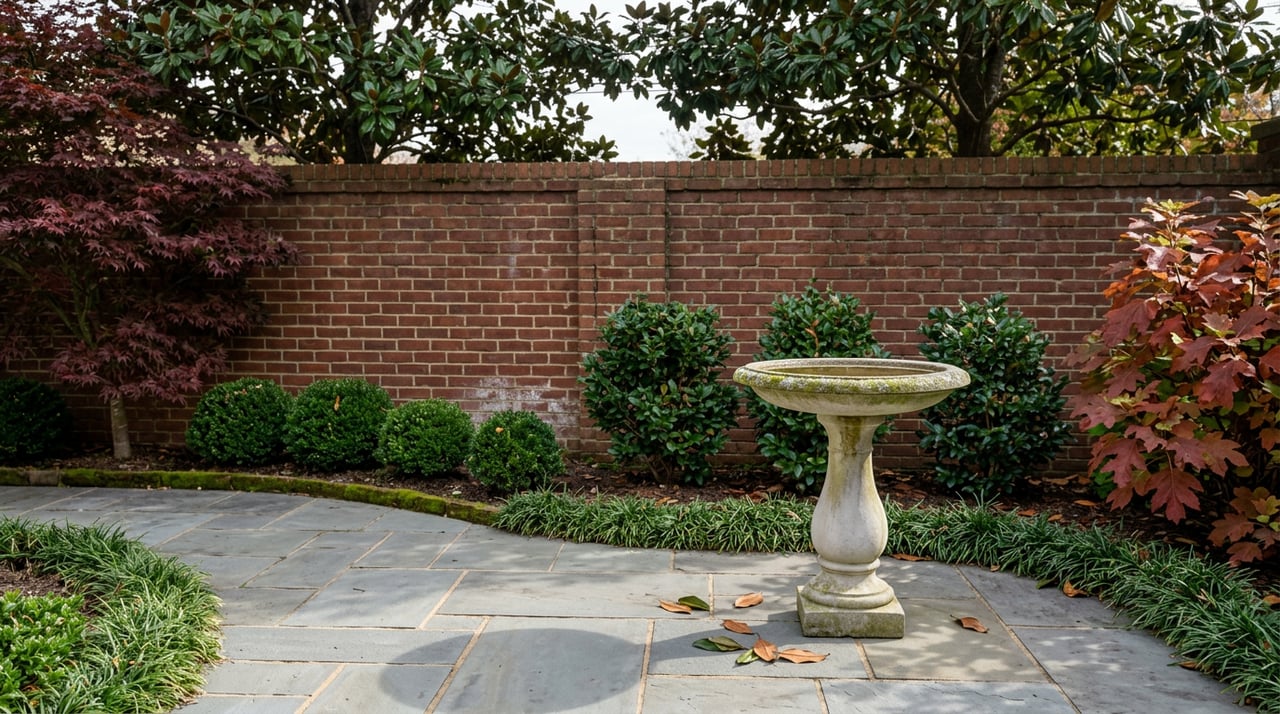
Every write-up of Wing Haven Garden & Bird Sanctuary uses the same word: hidden. A secret garden behind a brick wall. A hidden gem tucked into a residential block. One visitor's video caption put it plainly: it looks like you're walking up to someone's house. That's because you are. Wing Haven sits at 248 Ridgewood Avenue in Myers Park, between two other houses, on a street where people still live.
But call up the actual fall calendar for the garden's 100th anniversary and the secrecy angle falls apart. There's a food truck night in September. A three-day plant sale in October, with one day free to the public. A formal dinner marking the centennial later that month. None of it is hidden. It's scheduled, ticketed, and in some cases sold out months in advance to the same neighbors who supposedly just discovered it. The real story about Wing Haven this fall isn't that Myers Park has a secret garden. It's that the garden has spent a hundred years functioning as some of the neighborhood's most consistently used shared space, and the centennial season is the one stretch where you can see the whole operation running in daylight.
Ten Houses on Ridgewood Avenue
The garden's origin has nothing to do with landscape design. In 1926, Elizabeth and Edwin Clarkson moved to Charlotte from Texas and bought a house on Ridgewood Avenue with no trees on the property. They wanted to attract birds, so they planted for that purpose first and worried about aesthetics second. By the following year they had built what's now known as Wing Haven Garden & Bird Sanctuary, a private residence that slowly turned into a public one without ever stopping being a home.
Ten houses down the same street lived Elizabeth Lawrence, a garden writer whose work reached readers well beyond Charlotte. Her property became the Elizabeth Lawrence House & Garden, a working collection arranged so that something is blooming on any given day of the year. Two women, two doors apart on one residential block, each built a garden that outlasted them by decades and is still open today under one shared admission ticket. Wing Haven later added a third piece, the SEED Wildlife & Children's Garden, next door to the original Clarkson property, extending the same idea to a younger generation of visitors.
That's the part the "hidden gem" framing misses. This was never a park built by a city and later discovered by residents. It's two private gardens that neighbors kept open, on purpose, for a century, because the people who lived there decided that's what the block should offer.
The Calendar That Gives It Away
Here's what's actually scheduled between now and the end of October, according to Wing Haven's own event calendar:
| Date | Event | Access |
|---|---|---|
| Sept. 18, 2026, 5:30-8:00 p.m. | Food Truck & Music in the Garden | Open to the public, ticketed |
| Oct. 7, 2026 | Fall Plant Sale, Member's Day | Members only |
| Oct. 8-10, 2026 | Fall Plant Sale, public days (Oct. 10, 9 a.m.-5 p.m.) | Open to the public, free admission |
| Oct. 24, 2026, 6:00-9:00 p.m. | Centennial Fall Dinner | Ticketed benefit event |
Compare that to a normal week at Wing Haven. General admission runs Wednesday through Saturday, 10 a.m. to 5 p.m., at ten dollars a person, with children 10 and under free. During the fall plant sale, that admission fee disappears entirely for three straight days, donations accepted but not required. That's a real shift in how the garden treats access, not just a seasonal sale. The centennial isn't being marked with a plaque. It's being marked by temporarily removing the one barrier, the ticket price, that normally separates a passerby from the gardens themselves.
The Names on the Sign-In Sheet
The pattern of the garden functioning as shared civic space isn't new to this centennial year. Back in March, Wing Haven hosted a free morning session called Wildlife @ Wing Haven, built around education tables staffed by Carolina Raptor Center, Mecklenburg County Park & Recreation, Mecklenburg Audubon Society, the Myers Park branch of the Charlotte Mecklenburg Library, and TreesCharlotte. Advance registration was required to manage capacity, which tells you something about demand for what was, on paper, just a Wednesday morning program about backyard habitats.
The spring garden tour works the same way in reverse. Instead of Wing Haven's staff showing off the grounds, actual homeowners on the tour route open their own yards and talk through what they've changed over the years, what they inherited from previous owners, and what they're still working on. It's less a showcase and more a walking conversation among people who garden on the same soil and trade plants at the same nursery sales. That's not typical of a tourist attraction. It's typical of an institution that residents treat as an extension of their own front yards.
A Garden That Also Rents by the Hour
The clearest evidence that Wing Haven runs like infrastructure rather than scenery shows up in its rental sheet. A full-day rental of the Elizabeth "Pepper" Dowd Education Building runs $700 for eight hours, including setup and breakdown. A half-day runs $500. Members at the Sponsor level, which starts at $500 in annual giving, get a 10 percent discount on that rate, and nonprofits get 20 percent off. The SEED Wildlife & Children's Garden is available separately for kids' birthday parties, complete with raised garden beds, rain barrels, and a cedar pergola for picnic tables.
Set that against the $10 general admission ticket and you get the real range of what Wing Haven is built to do. On one end, a single visitor wandering through on a Saturday afternoon. On the other, a corporate retreat or a wedding-adjacent event booked months out, with a percentage discount built in specifically for the neighbors who already give money to keep the place running. A hidden secret doesn't have a published rate card. A working piece of neighborhood infrastructure does.
What the Rest of Myers Park Is Doing at the Same Time
None of this happens in isolation from the rest of the block. A few streets over, the three-mile loop along Queens Road West, Hopedale Avenue, and Selwyn Avenue that residents call the Booty Loop draws runners and cyclists every week of the year, and each July it closes to traffic entirely for 24 Hours of Booty, a cancer research fundraiser that has raised more than $28 million since 2002. That event is loud, public, and impossible to miss for 24 straight hours. Wing Haven's calendar sits at the opposite end of the same spectrum: quieter, ticketed in smaller batches, spread across a full season instead of compressed into one weekend. Together they say something about how this neighborhood treats shared space. It gets used, on purpose, by the people who live around it, whether that's a charity bike race or a hundred-year-old bird sanctuary.
For anyone who already calls Myers Park home, the practical takeaway is simple. Put September 18 on the calendar for the food truck night. Watch for the Fall Plant Sale details the first week of October, since a full plant list typically goes up online the Friday before. And if the Centennial Fall Dinner on October 24 is still open when you read this, it's worth checking directly with Wing Haven, since centennial-year tickets for a hundred-year-old garden tend not to sit unclaimed for long.
If you're weighing a move to this stretch of Charlotte and want a fuller sense of what daily life here actually looks like beyond one garden's centennial season, our local events guide tracks what's coming up across Myers Park and the surrounding neighborhoods year-round.
Whether you're settled on Ridgewood Avenue already or thinking about what it would take to get there, Katie Harrison knows this neighborhood block by block, calendar and all. Let's Connect.